Your driveway is the hardest-working slab of concrete on your property. Think about it. Your patio sees foot traffic and the occasional patio chair. Your sidewalk gets a snow shovel scraped across it a few times a winter. Your driveway, though? It carries 5,000 pounds of vehicle weight every time you come home, takes the brunt of every snowplow blade and salt application from November through March, and bakes in direct afternoon sun every summer day. It's also the first thing every visitor sees.
When a Layton driveway starts going, it goes fast. Hairline cracks become quarter-inch gaps. Joint failures turn into corner blowouts. That settled spot near the garage door? It only gets worse, never better.
We pour driveways for Layton homeowners. New construction, full replacements, extensions for RVs and trailers, decorative stamped upgrades, and structural repairs on slabs that still have life in them. Every job gets the prep, mix, and cure protocol Layton's climate actually requires.
Why Layton driveways fail before their time
Most of the concrete on your property is partially protected. Patios sit under eaves or pergolas. Garage floors live indoors. Sidewalks are short and rarely loaded. Your driveway has none of those advantages. It's exposed to every weather event, takes the heaviest loads, and gets the worst chemical exposure of any slab you own.
Then layer on what Layton specifically does to it.
The freeze-thaw cycle is brutal at this elevation. You'll see 40 to 50 nights a winter where the temperature crosses the freezing line, often within a single 24-hour period. Water that pooled on your driveway during the day sneaks into surface pores and joint seams, then expands as it freezes overnight. Each cycle pries the concrete apart a little more. Multiply that by 30 winters and you understand why pre-1995 driveways look the way they do.
Salt and deicer make it worse. The road salt that gets tracked onto your driveway from city plows, plus whatever ice melt you put down yourself, accelerates surface deterioration through a process called scaling. You'll see it as a flaky, pitted surface, usually starting near the apron and the garage entry where salt concentrates.
Sun exposure is the part most people don't think about. A south- or west-facing driveway in Layton can hit surface temperatures of 140°F on a July afternoon. Combine that with the colder mountain night that follows, and you get thermal expansion and contraction stress on top of everything else.
Underneath the slab matters just as much. A lot of older Layton lots, especially those developed quickly to house Hill Air Force Base families in the 1950s and 60s, were graded and built on minimally compacted fill. The newer subdivisions out by Mutton Hollow and along Hill Field Road generally have better subgrade prep because modern building codes require it. But if your home is from the post-war boom or the 1970s expansion, your driveway is almost certainly riding on subgrade that wasn't compacted to today's standards. Surface repairs on a slab with bad subgrade are putting lipstick on a deeper problem. Patching buys you a couple of years, but the slab will keep moving until somebody fixes what's underneath.
Signs you need a new driveway, not just a patch
A few cracks aren't a death sentence. Concrete cracks. That's just what concrete does as it cures and as the ground beneath it moves seasonally. We see plenty of 30-year-old slabs with hairline cracks that are still structurally fine. Cracks tend to show up first at the saw-cut joints, along the slab edges, and anywhere a buried utility runs underneath the driveway.
What tells you it's time for replacement:
- Multiple cracks wider than a quarter-inch running across the slab, especially if they're stepped or offset (one side higher than the other)
- Sunken sections of more than half an inch, which means subgrade failure underneath
- Spalling and surface scaling across more than 25% of the surface area
- Cracks at the joints that have separated so you can see daylight or accumulate dirt
- Heaving near the garage entry that's grinding the bottom of your garage door panels
If you've got two or more of those, repair money is wasted. We'll be honest with you. Some contractors will sell you a $3,000 patch job on a slab that needs full replacement. We won't. If the math says replace, we tell you replace. If it says repair, we tell you repair.
What we pour
New driveways for new construction
If you're building new, we work directly with your GC or pour as a separate trade. New construction lets us do everything right from the start: proper subgrade compaction, base aggregate to spec, rebar in a true grid (not just thrown in randomly), expansion joints positioned where the slab actually needs them, and a 4,000 to 4,500 PSI mix appropriate for residential vehicle loads. We've poured a lot of new construction across the East Layton foothill streets and the newer phases of West Layton.
Driveway replacement and tear-out
This is the bulk of what we do. Demolition of the existing slab, haul-off and disposal, regrade and recompaction of the subgrade, fresh road base, reinforcement, forms, pour, finish, and cure. A standard two-car driveway runs $4,500 to $9,500 depending on size, access, and tear-out complexity. Wider driveways with three-car garages or longer runs to detached shops scale up from there.
RV pads and driveway extensions
Layton has a lot of RV ownership. Hill AFB families, weekend warriors heading up to Snowbasin, retirees with travel trailers. If you've been parking a 30-foot trailer on grass, you're rutting your yard and stressing your tow vehicle's frame trying to maneuver. We pour reinforced RV pads designed for the actual weight of a loaded fifth-wheel or motorhome. That means thicker slabs (typically 6 inches versus the 4-inch standard for cars), heavier rebar, and proper drainage so meltwater doesn't pool under your tires all winter.
Decorative and stamped driveways
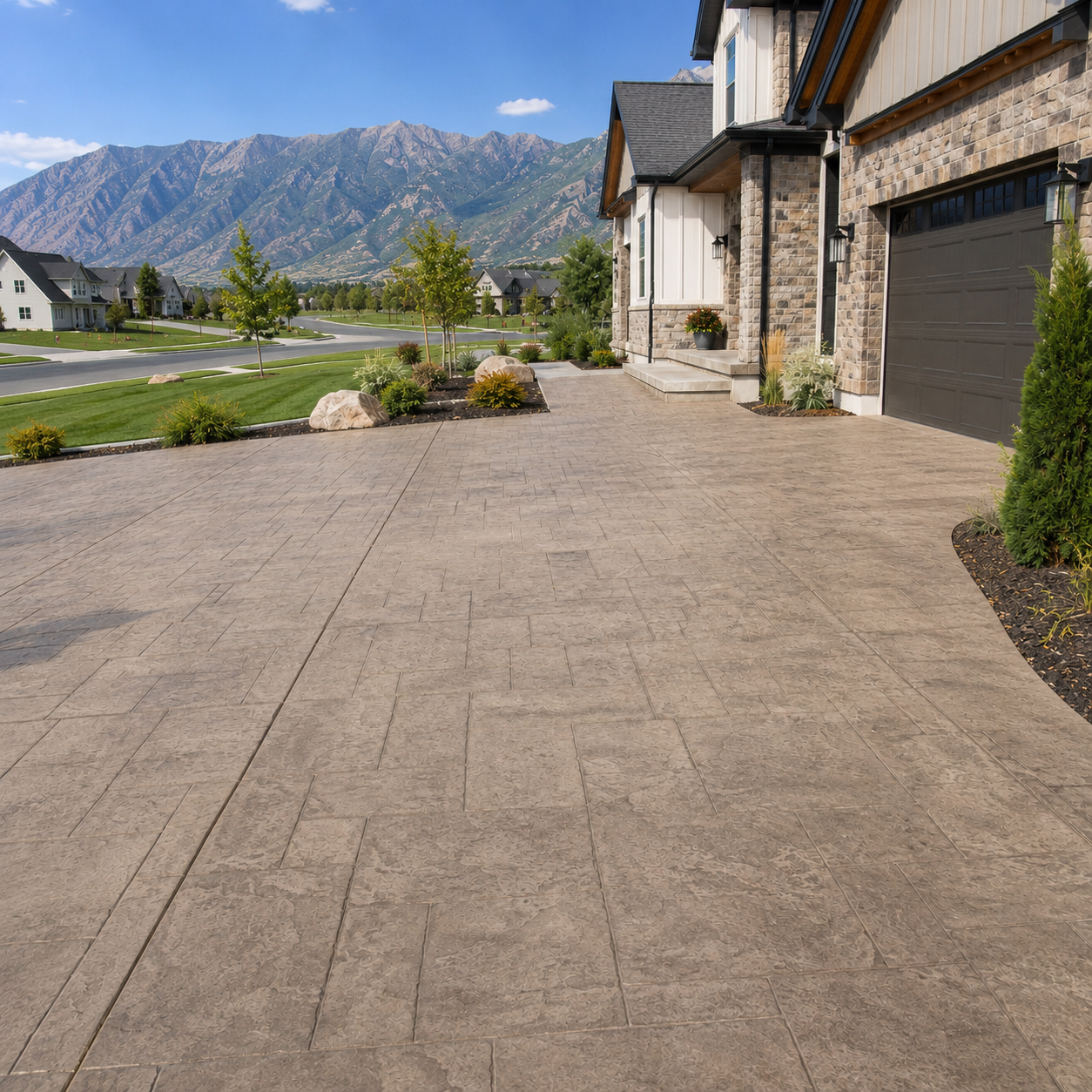
You don't have to settle for plain gray broom finish. Stamped concrete driveways with borders, color hardeners, or full-pattern stamps give you the look of pavers or flagstone for a fraction of the installed cost and with much less maintenance. Decorative scoring and saw-cut patterns are another option that adds visual interest without the cost of full stamping. Several of our recent jobs have been on bench-line homes with views toward Antelope Island where the homeowners wanted curb appeal that matched the architecture.
Apron and city-side transitions
The apron is the section of your driveway that connects to the public sidewalk and street. Layton City has specific code requirements for aprons, including minimum thickness, reinforcement, and slope. Get this part wrong and you'll have problems with city inspectors, drainage onto the sidewalk, or premature failure where the apron meets the street curb. We pour aprons to code every time, and we pull permits when permits are required so you don't have to navigate that yourself.
What the process looks like
Most driveway replacements take four to seven working days from tear-out to walkable concrete. The general process:
Day 1: Demolition. We break out the existing slab, load the debris, and haul it off. Your driveway is essentially a dirt patch by the end of the day. You will, of course, want to park on the street during the process.
Day 2: Subgrade work. Regrading, recompaction, base aggregate placement and compaction. Sometimes we hit unexpected issues here (old utility lines, soft spots from drainage problems, organic material that wasn't supposed to be there). We'll flag anything and discuss with you before adding cost. And we always mention this as a possibility before ever starting work.
Day 3: Forms and reinforcement. Wood or steel forms get set to your final dimensions. Rebar grid or wire mesh goes in. Expansion joints get positioned. We confirm slope to drain water away from your house and toward the street. This is always well worth the time and effort to get right. Water can do some crazy things.
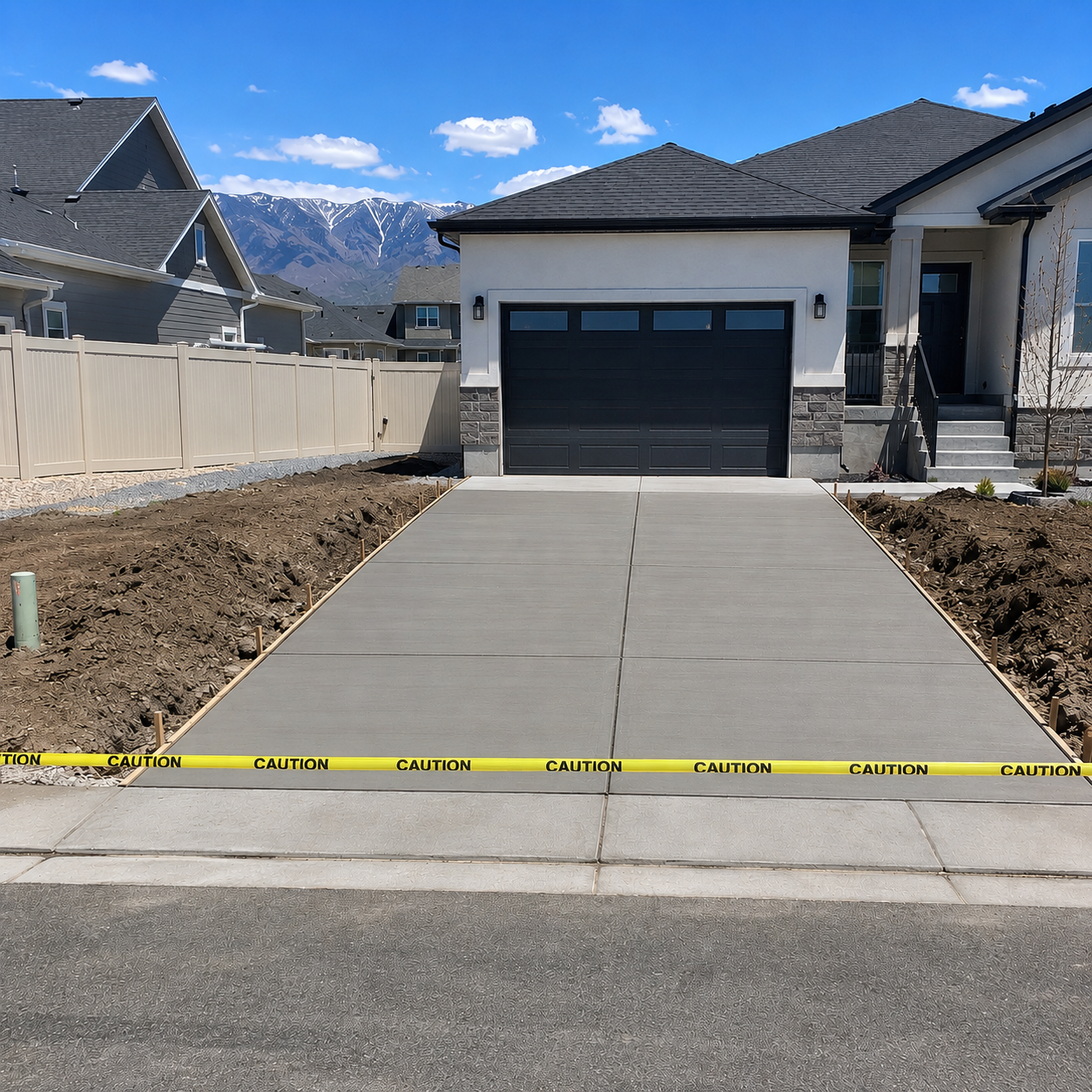
Day 4: Pour day. Concrete arrives by mixer truck, gets placed, screeded, floated, edged, and finished. Control joints get cut. Curing compound or wet curing blankets go on.
Days 5 to 7: Cure. You can walk on it after about 24 hours. You can drive a passenger car on it after 7 days. Full vehicle weight including loaded trucks and trailers should wait the full 28 days.
Where we work
We service all of Layton plus the surrounding Davis County cities. That includes the older established neighborhoods up against the bench, the newer developments out toward the Davis Conference Center and the FrontRunner station, and the bench-line communities you can see when you're driving up Highway 89. Mutton Hollow, the East Layton foothill neighborhoods, and the developments around Layton Commons Park and the Ed Kenley Amphitheater are all in our regular service area. If you're closer to Surf 'n' Swim or somewhere along Gentile Street, also covered. We work Kaysville, Clearfield, Syracuse, Farmington, Clinton, South Weber, and Roy as well.