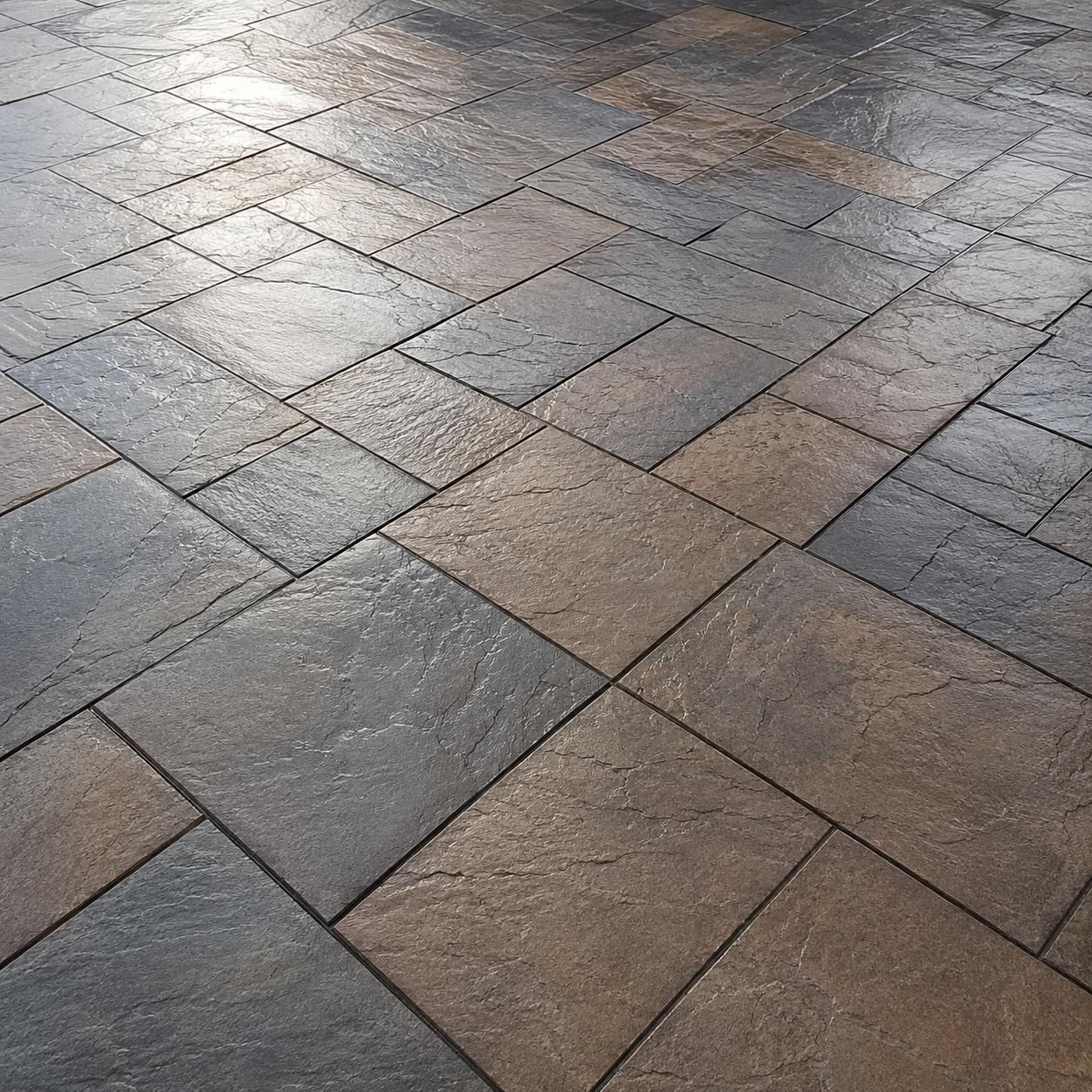
Stamped concrete is one of those upgrades that looks expensive but isn't, and looks complicated but isn't really. Walk a high-end Layton neighborhood and you'll see a lot of homes with what looks like flagstone or slate patios, brick driveway aprons, or stone-textured pool decks. Maybe a third of those are actually the real material. The rest are stamped concrete that mimics the look at roughly half the installed cost and with way less long-term maintenance.
We pour stamped concrete for Layton homeowners. Driveways, patios, walkways, pool decks, and accent borders. If you've been eyeing flagstone or pavers but flinching at the prices you're getting back from quotes, stamped is probably the move.
What stamped concrete actually is
The short version: it's regular structural concrete poured the normal way, then while it's still wet, we press patterned rubber mats into the surface to create the texture and joint lines of stone, brick, slate, or wood plank. Add color (or two colors, or three) and a clear sealer at the end, and you've got a slab that looks like masonry but performs like a single monolithic pour of concrete.
The reason that matters is performance. Real flagstone and paver patios have hundreds of joint lines where water can get under stones, where weeds grow, where individual stones can settle differently than their neighbors. Stamped concrete has none of that. It's one continuous slab with decorative texture on top. No joint failures. No shifting stones. No weed maintenance.
The color piece is where the craft is. Cheap stamped concrete uses a single integral color (added to the mix at the truck), which produces a flat, uniform look that's a dead giveaway it's fake stone. Good stamped concrete uses multiple layers: integral color in the mix, a color hardener broadcast onto the surface before stamping, a release powder applied just before the stamps go down, and sometimes a stain or antiquing wash applied later. The result is a finished slab with depth and variation that genuinely passes for real stone at conversational distance.
Why our climate matters more for stamped than for plain concrete
A few Layton-specific climate factors shape what stamped concrete needs to perform well.
High-elevation UV is the big one. Layton sits at roughly 4,400 feet. Sun exposure is more intense than at sea level, and concrete colors fade faster as a result. A stamped patio that gets full south or west afternoon sun can show visible fading by year 3 or 4 if it's not properly sealed and maintained. The same patio in coastal Oregon would look the same after 10 years.
Freeze-thaw is harder on sealers than on the concrete itself. The clear sealer that protects stamped concrete from staining and UV needs to be reapplied every 2 to 3 years here. In milder climates, you can stretch that to 5 or 6. Skip resealing in Layton and you'll see white efflorescence appear at the surface, color start to fade, and small surface cracks develop where water gets in and freezes.
Deicer is the silent killer. If a stamped surface sees winter salt or chemical deicers (driveway aprons especially), the surface can start scaling within just a few years if the sealer is compromised. The fix is straightforward: reseal on schedule, and use sand or pet-safe ice melt instead of straight rock salt anywhere the stamped surface meets your normal foot or vehicle traffic.
This past fall and early winter was instructive for color durability. Utah just posted its warmest November on record (44.4°F statewide average, beating the previous 2017 record by nearly 1.5°F per federal climate data) and then turned around and set the warmest December on record too, alongside all five Intermountain West states. The kind of unusually mild fall that keeps degrading sealers with UV exposure when they should be dormant under snow. The stamped surfaces we resealed in October before the cold hit are doing great. The ones that got skipped are showing wear early this spring.
Patterns we pour
There's basically four families of stamps we use most:
Flagstone and slate
The most popular pattern by a mile. Random, irregular joint lines that mimic natural stone laid by a mason. Reads as upscale, ages well, works on basically any home style from modern to traditional. Color combinations usually run earth tones — buff, sand, slate gray, terra cotta. Looks fantastic on patios and pool decks.
Brick and herringbone
Cleaner, more geometric. Looks best on traditional home styles (colonial, Craftsman, ranch). Works well on driveway aprons, walkways, and entry pads. Picks up dirt and stains less visibly than flagstone patterns.
Wood plank
A newer entry to the stamped world. Creates the look of weathered planks of wood, joints and grain texture included. Works surprisingly well for patio surfaces, especially under pergolas where the "deck" feel makes sense. Doesn't fit every home, but on the right house it's striking.
Ashlar and large-format tile
Big rectangular blocks with crisp joint lines. Modern, clean, geometric. Best on contemporary homes. We've done a few of these in the newer phases out near the Layton Utah Temple where the architecture leans modern.
A real story about picking the wrong pattern
Anyways, here's something most contractors won't tell you. The single biggest stamped concrete regret we hear from homeowners isn't about color or cost. It's about pattern choice. Specifically, they picked a pattern that doesn't match their home's architecture, and now they're stuck looking at it every day.
A couple in Sand Springs called me three years after another contractor poured a heavy cobblestone-pattern stamped driveway in front of their fairly modern 2018 two-story home. The pattern was beautiful on its own, but on that house it read as costume jewelry. Too rustic, too old-world for a home with clean lines and contemporary trim. They asked if we could "soften" the pattern. We couldn't. Stamped concrete is permanent. The only fix would have been a full grind-and-overlay or a tear-out.
The lesson is to spend more time on pattern selection than on color selection. Color matters, but color reads as a secondary feature. Pattern reads as the dominant look. If you have a modern home, go with ashlar or wood plank or a subtle slate. If you have a traditional home, flagstone or brick works. If you have a Craftsman or bungalow style, brick herringbone is hard to beat. Match the pattern to the architecture, then pick color second.
Where stamped concrete works best
Pool decks. Patios. Driveway aprons and accent borders along longer driveways. Front walkways and entry pads. Outdoor kitchen pads. Fire pit areas.
Where it's less ideal: full driveways (you'll spend a lot of money for a surface that mostly gets covered by cars). High-traffic commercial walkways where the wear pattern shows up unevenly. Anywhere that sees regular heavy equipment.
The maintenance reality
Every one of these stamped surfaces are going to need resealing every 2 to 3 years in this climate. Resealing a 400-square-foot patio runs about $300 to $600 if you hire it out, or about $80 in materials if you DIY (and the DIY version is genuinely manageable for most homeowners — clean the surface, apply with a roller, two coats).
What happens if you skip it: the sealer wears off, the color starts looking dull or chalky, water starts soaking into the slab instead of beading off, and eventually you'll get freeze damage to the textured surface that's much harder to fix than a $400 reseal.
What we tell every customer: put a reminder in your calendar for two years out from install date. Get it resealed at the two-year mark and you'll get another decade of great-looking concrete out of it.
Areas we serve
We work all of Layton plus the surrounding Davis County communities. The older established neighborhoods in Vae View and Whitesides have a lot of original concrete patios from the 80s and 90s that homeowners are upgrading to stamped overlays or full stamped replacements. Newer phases of Sand Springs are getting stamped pool decks and patios as part of original construction. If you're somewhere along Highway 193, near the Layton Utah Temple, or out by Layton Christian Academy, we cover you. We also handle Kaysville, Clearfield, Syracuse, Farmington, Clinton, South Weber, and Roy.