
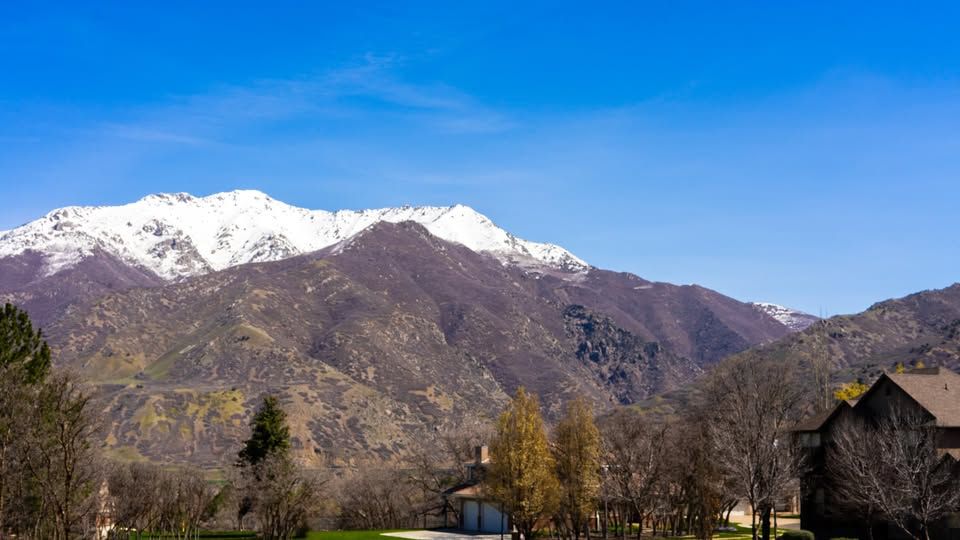


South Weber is the easternmost city in the service area, tucked into the corner where the Weber River curves out of Weber Canyon and the Wasatch foothills rise sharply toward the mountains. It's also the smallest city we cover, with a population around 8,000, and it has the most distinct geography of any service area on the list. Most of South Weber sits between the river to the south and the foothills to the north, on lots that step up the slope as you move further from the river.
What that geography does to concrete work is significant. Almost every driveway in South Weber has some kind of slope to deal with. Many of them have drainage challenges from being downhill of the canyon mouth. And the lots tend to be bigger and the construction more recent than what you'll find in central Layton or Clearfield, which means project profiles look different here than anywhere else in the service area.
The hillside reality of South Weber concrete
The first thing that defines concrete work in South Weber is the grade. A flat-lot driveway in central Clinton can be poured with a simple 1 to 2 percent slope toward the street for drainage and be done. A driveway in South Weber might need to handle 5 to 8 percent slope from the garage down to the street, plus account for cross-slope where the property steps along the contour of the foothill. That's a completely different engineering problem.
Pouring a sloped driveway correctly involves a few specifics that don't matter on flat lots:
- Proper forming and grading at the start. The sub-base has to match the final slope profile, with consistent thickness throughout. Variations in base thickness on a sloped pour translate directly into surface irregularities and weak spots once cured.
- Mix adjustments for slope work. Concrete poured on slope tends to want to flow downhill before it sets, which can cause aggregate segregation and inconsistent thickness. Lower-slump mixes (stiffer concrete that doesn't flow as readily) and sometimes the addition of plasticizers help control this. The contractor we partner with knows this on muscle memory.
- Cross-slope finishing techniques. Standard bull-floating on a slope can pull the cement paste downhill, which weakens the top of the slope and creates an uneven finish. Finishing crews working on slope have to adjust technique to keep the surface uniform.
- Drainage planning beyond the slab itself. Where does the water go when it runs off your sloped driveway? On a flat lot, it heads to the street and is someone else's problem. On a South Weber lot, it might be heading toward your neighbor's foundation, your own foundation, an irrigation system, or a landscaped slope that washes out under volume. Drainage planning is part of every quote here.
- The Weber River and Weber Canyon factor. Properties on the south side of the city near the river have additional considerations: high water table in some zones, flood-plain awareness in others, and proximity to the canyon mouth which channels stronger wind events during storm patterns. None of these are dealbreakers, but they're things the site visit accounts for.
Common projects in South Weber
Long full-length driveways on the larger lots. Many South Weber properties have setbacks of 50 feet or more from the street to the garage, which means significant driveway square footage. New pours, replacements, and extensions all show up regularly.
RV pads tucked behind the garage. The shop-and-garage culture from nearby Hill AFB plus the bigger lots make South Weber RV-friendly. Most RV pads are full-size, 12-by-40 feet or larger, with proper reinforcement and the slope and drainage planning needed for foothill lots.
Stamped patios on homes that back to open space or have views toward the canyon and the mountains. The visual setting drives demand for finished, decorative concrete work that integrates with the natural backdrop.
Plain concrete patios for homeowners who want generous outdoor living space without the stamped premium.
Garage floors and shop slabs for the meaningful subset of South Weber homes with detached shops or oversized garages. The shop-culture demographic that spills over from Roy and the Hill AFB community is well-represented here, especially on the larger lots.
Driveway replacement on older homes near Old Maple Road and the more established parts of the city. Less common than new pours, but a steady portion of the work.
Neighborhoods and areas of South Weber we serve
The Old Maple Road corridor. One of the older established parts of the city, with homes going back to the 1970s and 80s. Driveway replacement, repair work, and additions for homeowners who've been in their properties for decades.
The eastern subdivisions toward the canyon mouth. Newer construction on the slope rising toward the foothills. New driveway pours, patios with views, and RV pads on the lots that support them.
The neighborhoods south of Highway 89 toward the river. Mix of established and newer homes. Drainage considerations matter more here because of proximity to the Weber River and the lower elevation.
The Cottonwood Cove area and the developments along South Weber Drive. Mid-2000s through current construction, with some of the larger lots in the city. Common projects include full driveways, oversized garage slabs, and decorative patios.
The bench above 1900 East. Higher-elevation lots with the steepest slopes in the service area. These properties often need the most engineering attention on drainage and grading.
The Cherry Creek and Riverdale border areas. South Weber blends into Riverdale on the north and Uintah to the east. Projects on the border streets often share characteristics with whichever neighboring city is closer.
If your home is anywhere within South Weber city limits, you're within the service area. The drive from Layton runs about 15 minutes via I-84, which is on the regular route.
Why drainage planning matters more here than anywhere else
This is the part that earns its own section, because it's where South Weber concrete work meaningfully diverges from anywhere else in the service area.
Water running off a driveway has to go somewhere. On a flat city lot, the question barely matters. The water runs into the gutter, the gutter carries it to a storm drain, the storm drain takes it away. The homeowner never thinks about it.
On a sloped South Weber lot, the question matters a lot. Surface runoff from a 1,000-square-foot driveway can produce a meaningful volume of water during a moderate storm. If that water has nowhere planned to go, it finds its own path: toward the foundation, toward a low corner of the yard that floods, toward a downhill neighbor's property, or into the landscaping where it can wash out plantings and erode soil.
Proper drainage planning for a sloped driveway might include:
A cross-slope built into the pour so runoff sheds to the lower side rather than running straight down the centerline. A drainage swale or curb along the lower edge to channel water toward a planned outlet. A French drain or perforated pipe at the base of the driveway to handle volume in heavy storms. Connection to existing yard drainage where it exists, or planned routing to natural drainage where it doesn't.
None of this is exotic engineering. It's standard practice on sloped properties. But it's the kind of work that gets skipped when a contractor is unfamiliar with hillside lots or trying to come in low on bid. The result of skipping it shows up two or three winters later, when the first really wet spring runs water somewhere it wasn't supposed to go and the homeowner is suddenly dealing with foundation issues, washed-out landscaping, or a flooded basement that traces back to a driveway built without enough thought.
The site visit on a South Weber project always includes drainage planning. It's worth more than the slope of the slab itself, in many cases.