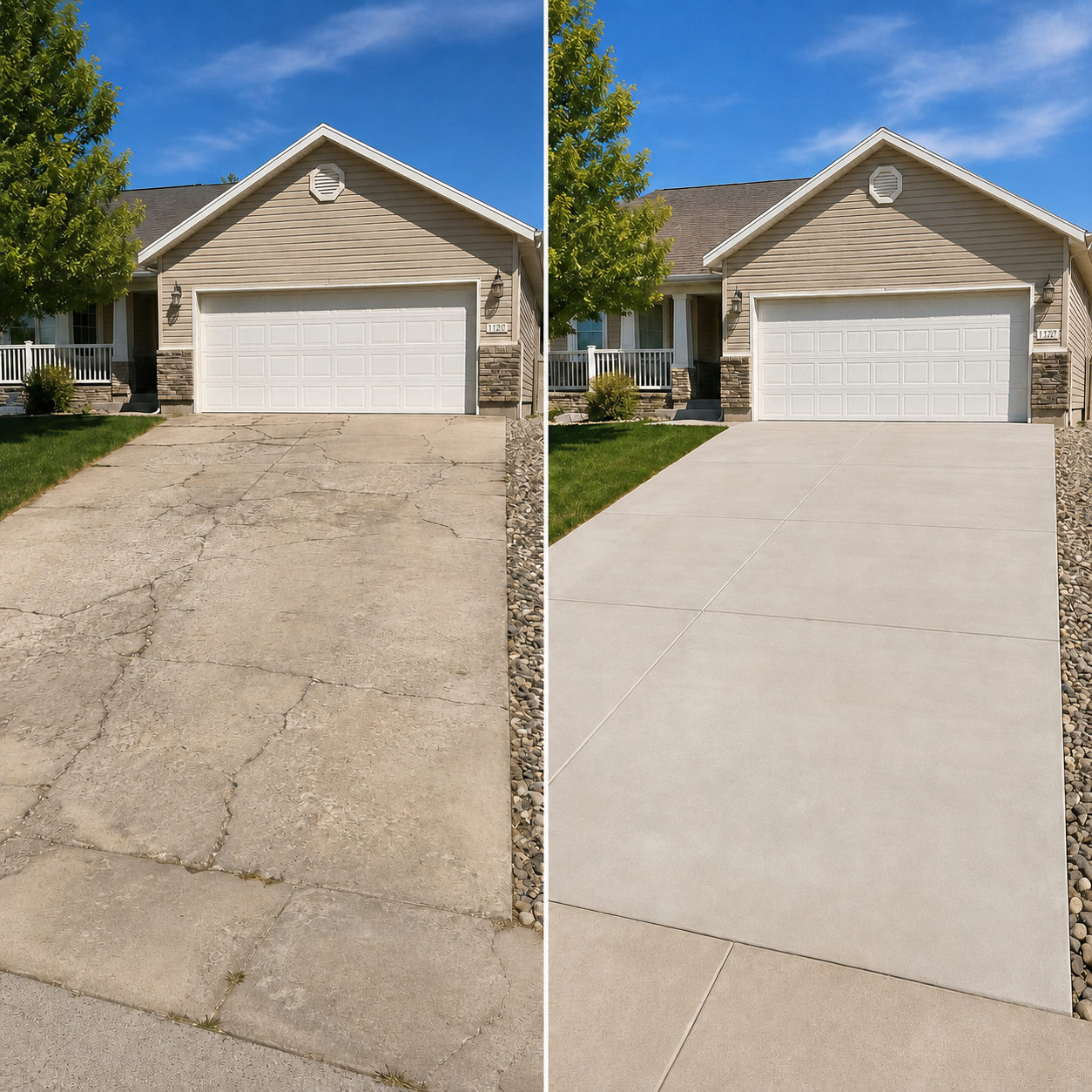
Most homeowners who call us about repair are torn between two stories. The first contractor told them their slab is fine, just needs a little patching. The second contractor told them they need a full tear-out and replacement, today. They want someone to give them a straight answer about what their concrete actually needs.
That's most of what we do on this side of the business. We come look, tell you what you've got, and recommend the smallest repair that will actually solve the problem. If you can get another 15 years out of a slab with $800 of work, we'd rather do that then sell you a $7,000 replacement you don't need.
We handle three categories of work on existing concrete: structural repair (cracks, joint failures, surface damage), resurfacing (overlays and refinishes that give old slabs a new look), and full slab replacement when nothing else makes sense.
Why concrete in Layton ages the way it does
Most of the slabs we look at were poured between 1965 and 2005. That's a lot of homes in this town. Anything older than that has usually been replaced once already, and anything newer is generally still inside its first lifecycle.
The concrete that came out of Davis County batch plants in the 70s and 80s was a different animal than what we pour today. Mixes were leaner, often 3,000 PSI instead of today's 4,000 PSI standard. Slab thicknesses were sometimes 3 inches when they should've been 4. Reinforcement was inconsistent. Some lots got proper rebar, plenty got nothing at all. None of that was malicious, it just reflected where the industry was at the time.
What that means for you, the homeowner of a 30 to 50 year old slab in Layton: your concrete has been working harder than it was designed for, in a climate that's harder on concrete than most.
This past winter brought that into focus. Salt Lake City just wrapped its warmest meteorological winter on record, running more than 7°F above average from December through February. Statewide snowpack hit a record low in early February. For your concrete, that meant something unusual. Instead of staying frozen and dormant for months, slabs went through dozens of unusual freeze-thaw swings as temperatures bounced between the 50s during the day and the low 20s at night. Water that should've stayed frozen kept melting, soaking in, and refreezing. We're already seeing more spring damage calls in 2026 than we did the previous two springs combined.
When repair is the right call
Repair makes sense when:
- Cracks are hairline to roughly a quarter-inch wide, with no significant offset between the two sides
- The slab is generally level, with no major settlement
- Surface damage is limited to specific areas (under a downspout, near a salt-shoveled walkway, around a hose bib)
- The slab is otherwise structurally sound
Common repairs we handle:
Crack injection and routing. For non-structural cracks that are causing aesthetic issues or letting water through, we route the crack out to a clean profile and fill with polyurethane or epoxy. Good for another 10-15 years on most slabs.
Joint resealing. Expansion joints and control joints fail over time. The original sealant degrades, dirt and rocks pack in, and water gets where it shouldn't. We clean out failed joints, replace the backer rod, and reseal with quality polyurethane sealant.
Concrete leveling. When a slab has settled but is otherwise intact, we use polyurethane foam injection (much cleaner than traditional mudjacking) to lift it back to grade. Faster, less mess, and the foam doesn't degrade like the sand-cement slurry old-school mudjackers used. A typical leveling job runs $400 to $1,800 versus $4,000+ for full replacement.
Spot replacement. If one section of a driveway or sidewalk is damaged but the rest is fine, we can saw-cut and replace just the damaged area. Color won't match perfectly, but you save thousands compared to full replacement.
When resurfacing makes sense
Resurfacing is overlay work, a thin layer of new concrete or polymer-modified material bonded to your existing slab. It's the right answer when your slab is structurally sound but cosmetically rough. Surface scaling, light cracking, faded color, dated finish, dingy stains.
We do polymer-modified overlays in standard finishes, stamped overlays that mimic flagstone or tile patterns, micro-toppings for a smoother modern look, and spray-down textured finishes for pool decks and patios where slip resistance matters.
Resurfacing works best on patios, walkways, and pool decks that are structurally fine but visually tired. It is NOT a fix for slabs that have settled, that have cracks wider than a quarter inch, or that have ongoing moisture problems from below. We've gotten calls from homeowners who paid another contractor to resurface a settled patio, only to watch the overlay crack apart in less than a year because the underlying problem was never addressed.
Here's a strong opinion that'll save you money. Stay away from the "concrete restoration" products you can buy at the big-box stores. The five-gallon buckets of "resurfacer" that promise to make your old concrete look new for $200 of materials and a Saturday afternoon? Those products are real, they sometimes look fine for 18 months, and they almost always fail by year three. The bond doesn't hold up to Layton's freeze-thaw cycles. Once they start delaminating, you've got a worse problem than what you started with, because now you're paying us to grind off all the failed coating before we can do real work. Last spring we had a homeowner over near Park Meadows who'd spent $600 on three failed DIY resurfacing attempts before calling us. The grind-off and proper resurface cost him more than it would have if he'd just called first.
When you need full replacement
Sometimes the slab is just done. The signs:
- Multiple cracks wider than half an inch, with elevation differences between the two sides
- Major settlement that's affected the slope or drainage
- Reinforcement that's rusting and pushing through the surface (you'll see brown stains and pop-outs)
- Crumbling at the edges with chunks coming loose
- Surface scaling across more than 30 to 40% of the slab
- Concrete poured before 1970 that's at the end of its design life regardless of visual condition
When we recommend replacement, we'll explain exactly why repair won't get you where you need to be. We've turned down repair jobs that homeowners wanted us to do because we knew the slab was past saving and the money would've been wasted. Honest beats easy, every time.
Where we work
We service all of Layton plus the surrounding cities in Davis County. The older established homes in Lakeview Estates and Villages of Vilano are seeing a wave of repair work right now as their original 80s-era slabs reach the end of their lifecycle. Park Meadows is mixed, with some homes new enough to have decades left and others ready for full replacement. If you're somewhere along US-89 between Layton and Kaysville, or out near Layton High School, we cover you. We also work Kaysville, Clearfield, Syracuse, Farmington, Clinton, South Weber, and Roy when our schedule allows.
If your home is closer to the Heritage Museum of Layton on the east side, or you spend weekends out at Powder Mountain and you're trying to figure out what to do with that cracked driveway before next winter, get on our schedule now. The dry, warm spring of 2026 has us working earlier in the season than usual, and the calendar is filling fast.